
_Low.jpg)
by Dan Roscoe, President of Renewall
Most people only think about electricity when something disrupts the routine. The bill arrives higher than expected. The power goes out during a storm. A price hike gets announced and suddenly everyone is paying attention. The rest of the time, electricity is background noise, something that just works.
Before a wind turbine rises, a lot has to happen on the ground.
At Mersey River Wind in Queens County, that work is now underway in visible, practical ways. Access roads are advancing. Substation foundations are being poured. Transmission preparation has started. Turbine pad sites are being prepared. Crews, equipment, materials, and technical partners are now active across the site.
For Renewall customers, these early construction milestones are part of the path toward choosing locally generated renewable electricity.
There are three connected names behind this work.
Mersey River Wind is the wind farm being built in Queens County. It is where the renewable electricity will be generated.
Renewall is the renewable energy provider that will give homes, small businesses, and larger organizations a way to choose locally generated renewable electricity.
Roswall is the renewable energy developer behind the project. Corporately, Roswall owns Renewall and manages the development, construction and operation of Mersey River Wind.
Put simply: Mersey River Wind generates the power. Renewall brings that electricity choice to customers. Roswall is the developer and owner bringing the full system together.
As construction progresses, recent dryer weather has helped road work progress across the site, with some access roads now complete. These roads are essential because they allow crews, concrete trucks, cranes, service vehicles, and eventually unbelievably large wind turbine components to move safely between work areas.
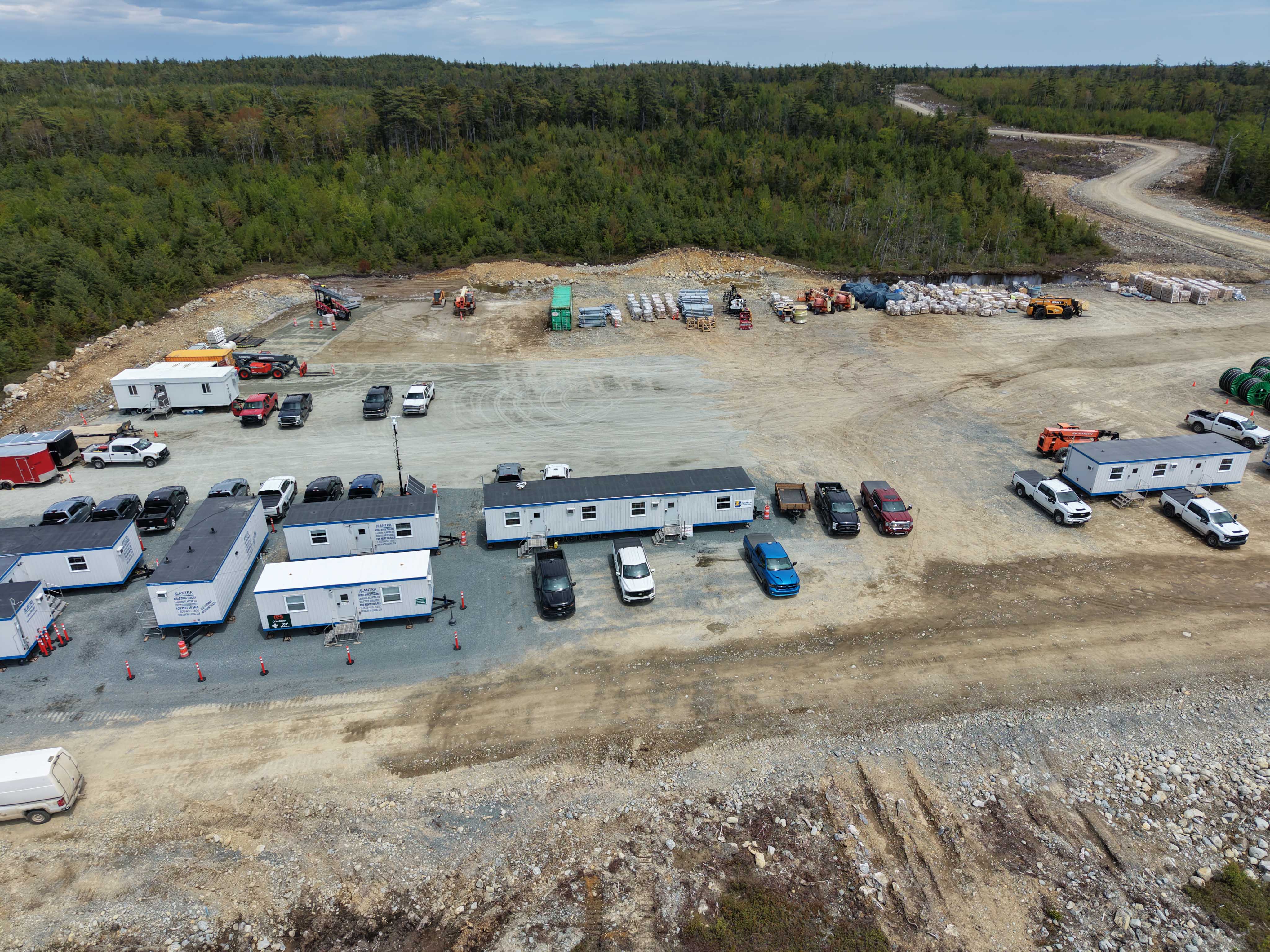
The site’s laydown area is also active. A laydown area is the construction staging hub where trailers, vehicles, equipment, materials, and supplies are organized before moving to different parts of the project. It may not be the most recognizable part of a wind farm, but it is one of the places where the coordination behind construction becomes easiest to see.
Substation foundation pours have started as well. Crews are placing concrete and rebar for the electrical infrastructure that will help collect and manage power from the wind farm. The substation is also where important protection and control systems are located, making it one of the technical centres of the project.
Also underway is the process of transmission line pole preparation. In some areas, that includes controlled rock breaking where poles will be set. This work prepares the ground for the infrastructure that will help move electricity from Mersey River Wind toward the broader grid.
Wind Turbine Generator pad site work is ongoing with some pad sites now complete and ready for foundation excavation. Once that excavation begins, rebar and concrete placement will follow. These are the places where the turbines will eventually stand.
There are now roughly 90 people working on site, with more being added as construction activity increases. Vestas representatives are also currently on site as the project moves into its next phase.
The turbines will eventually be the most visible part of Mersey River Wind, but the current work is what makes that possible.
The project is being built in Queens County, but its impact will reach across the province, helping to support homes, businesses, municipalities, and community organizations looking for renewable electricity generated right here in Nova Scotia.
There is still significant work ahead, but the progress on site is an important step forward. Clean energy is soon to be a reality for Nova Scotians, and Renewall customers are getting closer to a new way to power their homes, businesses, and communities.
Learn more about Renewall and how to get ready for locally generated renewable electricity.
Dan Roscoe is the President of Renewall Energy, a renewable energy provider, and CEO of Roswall Development, a renewable energy developer, both based in Halifax, Nova Scotia. His work is focused on building the infrastructure for a cleaner, smarter energy future across Canada and beyond.


